
Empowering women in Michigan
AAUW has been empowering women as individuals and as a community since 1881. For more than 130 years, we have worked together as a national grassroots organization to improve the lives of millions of women and their families.
AAUW of Michigan Mission
AAUW advances gender equity for women and girls through research, education, and advocacy.
AAUW’s Vision
Equity for all.
AAUW’s Values
Nonpartisan. Fact-based. Integrity. Inclusion and Intersectionality.

Find a Branch and Join Us in Advocating for Gender Equity!
Public Policy and Advocacy
AAUWMI’s public policy and advocacy work seeks to empower women and girls in Michigan.

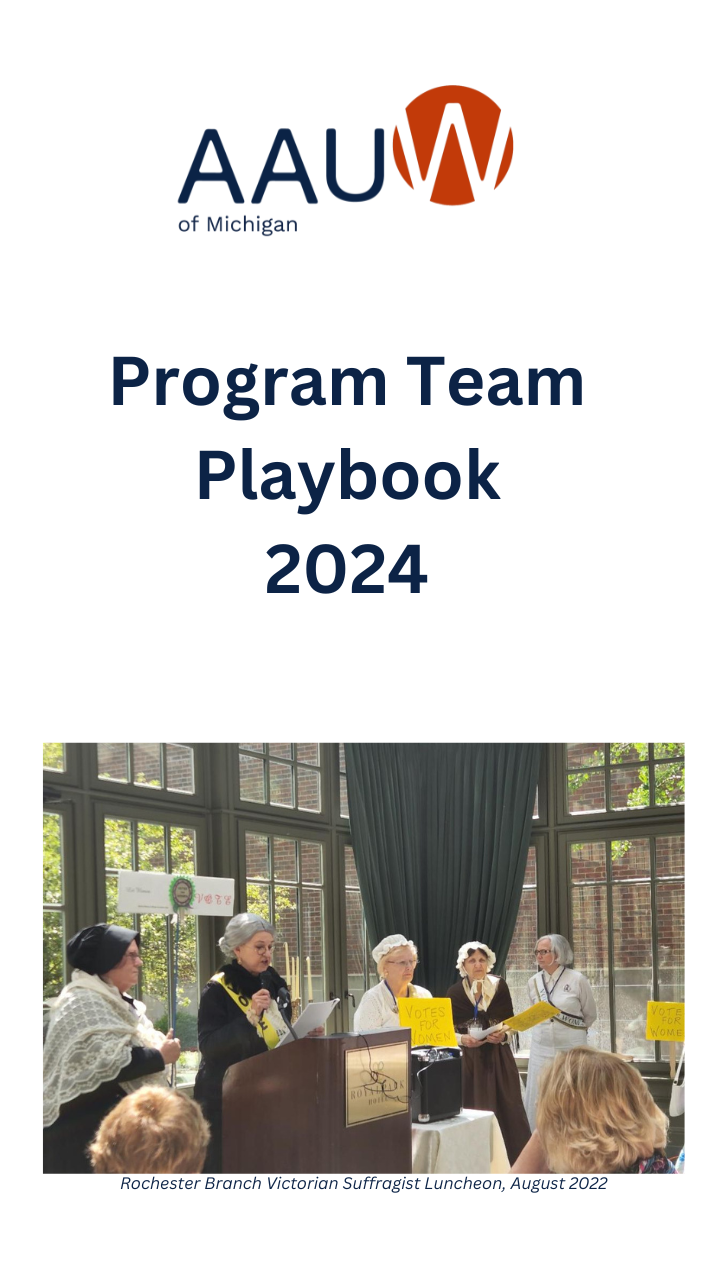
Branch Leadership Playbooks
AAUW of Michigan is producing a series of branch leadership playbooks to assist branch officers and the collaborative teams they assemble, both formal and informal, to assist in performing their responsibilities. These playbooks are designed to be scalable for use by small, medium, and large branches. We hope the playbooks will help branches recruit new officers by making the jobs appear manageable, satisfying, and occasionally even fun. We welcome suggestions for updates and additions to future versions of the playbooks. Please send comments to .
AAUW of Michigan Newsletters
- Summer/Fall Newsletter – September 15, 2026
- Spring/Summer Newsletter– June 11, 2026
- Winter/Spring Newsletter - March 11, 2024
- Fall/Winter Newsletter – December 10, 2025
- Summer/Fall Newsletter – September 16, 2025
- Spring/Summer Newsletter – June 11, 2025
- Winter/Spring Newsletter - March 11, 2025
- Fall/Winter Newsletter – December 10, 2024
- Summer/Fall Newsletter – September 10, 2024
- Spring/Summer Newsletter – June 1, 2024
- Winter/Spring Newsletter - March 1, 2024
Community Connection
Welcome to the Community Connection, a place to view our e-blasts from your state organization. We promise to keep theCommunity Connection short, timely, and geared toward our members (that’s YOU) with what YOU might want to know or do to be an active AAUW member.
- 2025 AAUWMI Branch Presidents’ Packet
- AAUW of Michigan Statement on Open Membership
- AAUW of Michigan Statement on Child Marriage
- AAUWMI’s Role in “Adopt and Amend” Court Ruling
- AAUW of Michigan Statement on Racism
- AAUW of Michigan Statement on Domestic Terrorism
- AAUW of Michigan Statement on Michigan Voting Rights
Diversity, Equity, and Inclusion Toolkit
The AAUW Diversity, Equity and Inclusion (DEI) resources in the DEI Toolkit aim to identify best practices for promoting diversity, equity and inclusion within AAUW. These resources present guidelines for how AAUW branches, national members, student members and individual members can demonstrate an understanding of AAUW’s mission, values, goals and strategic plan. It is meant to start the inclusion conversation. We encourage all members to seek ways to incorporate inclusive practices into their branches and daily life.
AAUW of Michigan Webinars
AAUW of Michigan presents Webinars on topics related to our mission. See some of our most recent presentations below. Find our complete archive of recordings on YouTube. For information about upcoming webinars and other events, see our calendar.
 Revisiting the 2022 Election and the Future of Democracy, 2/9/2023
 Recruiting and Engaging Younger Members Panel Discussion, 6/26/2023
 Ranked Choice Voting for Michigan, Ron Zimmerman of Rank MI Vote, 9/14/2023
 It’s in the Numbers!: Financial and Fundraising Information for Your AAUW Branch, 1/16/2025
AAUW of Michigan Facebook Page


AAUW of Michigan
(opens in a new tab)www.aauwmi.org

Upcoming Events and Observances